
You bought it, then realised there is no English edition
A convention haul arrives, or you finally buy that circle's new book on DLsite — and then it lands: doujinshi almost never get an official English release.
Commercial manga at least has publishers who might license it. Doujinshi has no such path. The author is one person or a small circle with no localisation budget and no reason to build one, and a title being popular overseas does not mean anyone is going to translate it. Being able to buy it and being able to read it are two separate problems in this corner of the hobby.
DLsite does run an official community translation programme where buyers translate a work and publish it, but it only covers titles whose creator opted in — the book you just bought is probably not one of them. After that, reading it is on you.
Why doujinshi is harder to auto-translate than commercial manga
If you have used a manga translator before, doujinshi will feel like a step down in success rate. That is not the tool slacking off — four things stack up at once:
- Handwritten dialogue. Commercial volumes are typeset in a real font. Doujinshi frequently have whole pages of the author's own handwriting, which is a completely different recognition problem.
- Sound effects drawn into the art. They are part of the drawing, not text laid on top of it, so there is nothing clean to lift out and nothing clean to put back.
- Tight speech bubbles. English usually runs longer than Japanese, and a bubble sized for three vertical lines of Japanese has very little slack.
- Uneven print and scan quality. Recognition works on pixels. Heavy screentone and low resolution eat the fine strokes that separate similar characters.
This is the state of the field in 2026, not one product's weakness. Calibrate accordingly: expect most of the dialogue to become readable and expect handwritten asides and sound effects to be missed.
Three ways to read the one you own
1. Grind through it with a dictionary
Slowest, but genuinely workable for art-heavy books with sparse dialogue. Best if you already read some Japanese and only get stuck on vocabulary.
2. Screenshot into a translation app
Capture the page, drop it into a phone translator. Fine for checking a panel or two, but reading a whole book means constant window switching — and these tools mostly overlay the detected text rather than typesetting it back into the bubble.
3. Translate in the browser as you read
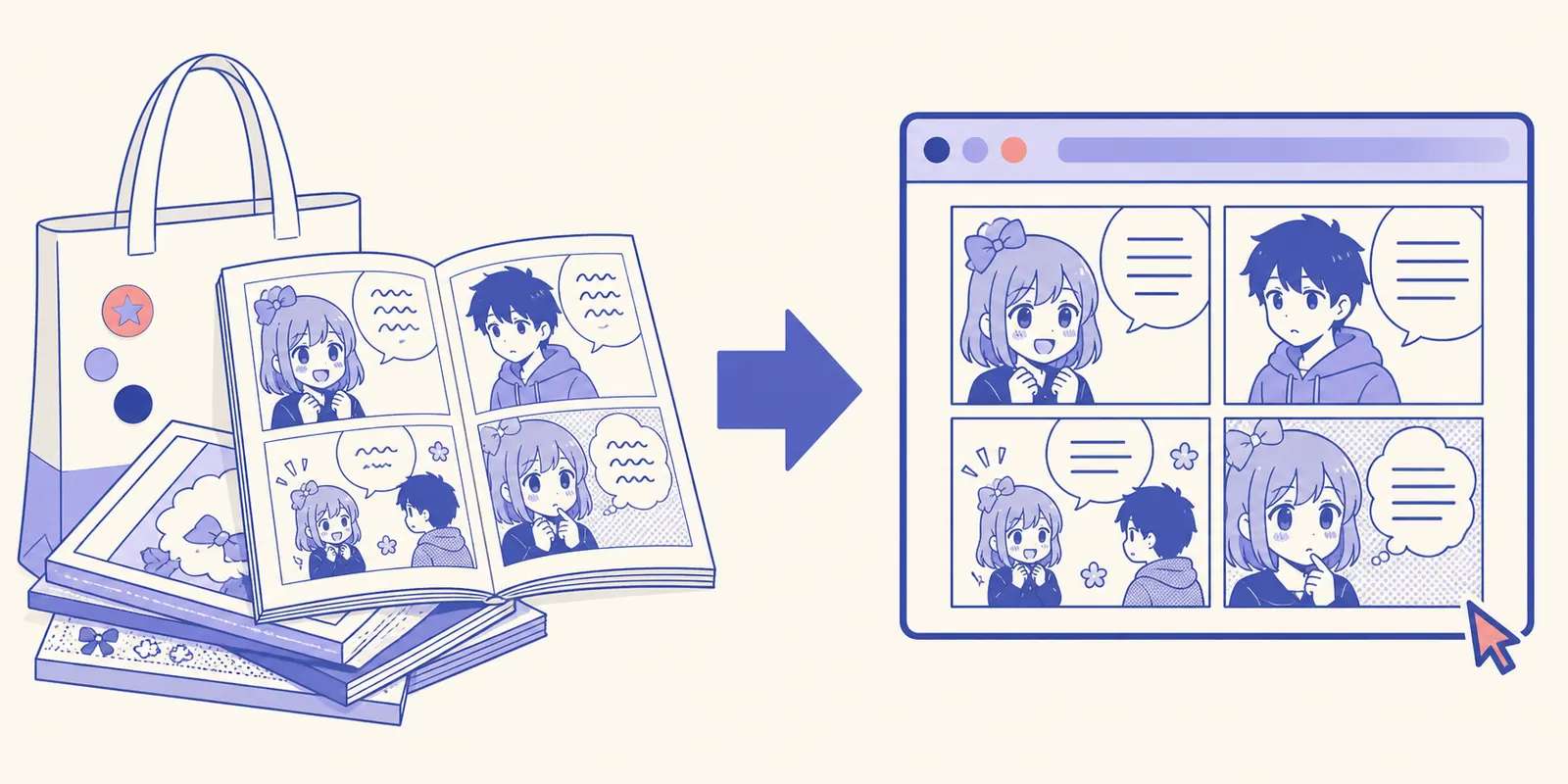
Translate the page you are already looking at, with the result rendered back into the speech bubbles. It is the only option that lets you read a book start to finish without breaking stride, provided the platform is supported.
The full comparison lives in the manga translator tool guide.
Reading on DLsite and Melonbooks
Loomic's compatible-site list includes DLsite, Melonbooks, FANZA Books and pixiv Comic. On those sites' browser readers, the Chrome extension translates the page in place: it detects the speech bubbles, covers only the area the text occupies, fills that area with a texture that continues the surrounding art, and typesets the translation back in a matching font.
If what you bought is a downloadable image file instead, the web upload tool at loomic.io handles it — the flow just changes from "read and translate" to "translate, then read".
Pricing is credit-based: one image is normally one credit, dense pages cost a little more. Run the free allowance over a book you actually own before paying for anything — that tells you more than any demo page. Details on the pricing page.
Three things worth checking before you buy
- Whether an official English edition exists. If it does, buy that one. A human translation will beat any automatic one.
- Whether the work is readable in the browser. Download-only releases add an upload step; titles with an online reader can be translated as you read.
- Whether the preview pages are handwritten. The preview usually reveals the book's text style. A heavily handwritten book deserves lower expectations.
Where the line is
Translating something you bought and reading it yourself is personal use. Uploading the translated pages, reposting them, or turning them into a "scanlation" release is not — and the person it takes money from is the individual creator you just paid.
Doujinshi exists because readers pay creators directly. A translation tool should let you read what you bought, not help the book leak.
FAQ
Do doujinshi on DLsite have English versions?
A small share do. DLsite's community translation programme only covers titles whose creator opted in; if the circle never opted in, no English edition will appear.
Can I translate a doujinshi I bought?
Yes, for your own reading. Uploading, reposting or distributing the translated pages is not personal use.
Is doujinshi harder to translate than commercial manga?
Usually — handwritten dialogue, sound effects drawn into the art, tight bubbles, and uneven print or scan quality.
Does Loomic work on DLsite and Melonbooks?
Yes. The compatible-site list includes DLsite, Melonbooks, FANZA Books and pixiv Comic; browser readers translate in place, downloaded image files go through the web upload tool.